
How AI Is Transforming Placement Readiness in Colleges
For years, placement prep meant aptitude tests and a handful of mock interviews before drive season. In 2026, AI is quietly rebuilding the whole model — and the institutions adapting are pulling ahead on the metric that matters most: offers.
Every placement season runs on roughly the same playbook: aptitude drills, a coding sheet, and a few mock interviews squeezed into the weeks before companies arrive on campus. It worked when hiring was predictable. In 2026, it no longer is — and the playbook is starting to show its age.
The numbers expose the gap clearly. India's graduates are increasingly "employable" on paper — the India Skills Report 2025 placed overall employability near 55% — yet a large share never convert that into an offer. And the reason employers give, year after year, is not aptitude. It is communication.
Placement readiness has quietly stopped being a test-prep problem and become a communication problem. AI is the first tool that can fix that at the scale a campus actually needs.
The old model is quietly breaking
Hiring has shifted under everyone's feet. The IT services sector that once absorbed lakhs of freshers has pulled back sharply, while Global Capability Centres and product firms are expanding — and they interview differently. Group discussions, multiple rounds, case-style questions and AI-assisted screening now sit between a student and an offer. In that environment, aptitude is table stakes; it gets you shortlisted, not hired.
What separates the student who converts from the one who doesn't is rarely another mark on an aptitude test. It is whether they can think clearly out loud, answer a behavioural question with structure, and hold a conversation with a recruiter without freezing. None of that is trained by a coding sheet.
More than half of graduates who clear the technical bar still fail interviews on poor spoken English or presentation — not on competence. A capable student routinely loses the seat to a more articulate one.
Source: reporting on the Unstop Talent Report 2025 / India Skills Report 2025The real bottleneck: communication at scale
Most placement cells already know this. The problem has never been awareness — it has been scale. Giving every one of a few thousand students enough personalised speaking practice, with real feedback, is simply impossible with a handful of trainers and a calendar that fills up the moment drive season starts. So communication training becomes a one-off workshop, and the students who need it most get the least practice.
This is exactly the constraint AI removes. An AI speech engine can listen to a full spoken answer and give feedback on pronunciation, pace, clarity and fluency instantly — for one student or for three thousand, at the same cost. Practice that was rationed becomes unlimited, and the quiet students who would never speak up in a crowded workshop get to rehearse privately, as many times as they need.
"Practice that was rationed becomes unlimited, and the quiet students who would never speak up in a crowded workshop get to rehearse privately, as many times as they need."
What AI actually changes for a placement cell
Strip away the hype and the value to an institution comes down to four concrete shifts:
Practice without the faculty bottleneck
AI mock interviews and speaking practice run anytime, for any number of students, with no trainer scheduling.
Personalised to each student's gaps
Instead of one-size workshops, every student works on their own weak spots — pronunciation, structure, confidence.
Measurable readiness, not guesswork
Dashboards replace Excel sheets, giving TPOs real-time visibility into who is job-ready and who needs support — before drive season, not after.
Consistent quality across departments
Every student gets the same high standard of feedback, regardless of which faculty member is free that week.
From activity to outcomes
The most important shift is how success gets measured. For too long, placement readiness has been reported as activity — number of workshops held, sessions conducted. Recruiters and accreditation bodies care about outcomes: offers made, and proof that students are genuinely employable.
This is where AI quietly does double duty. The same engine that trains students also generates the employability data institutions increasingly need — readiness scores, skill progress, and certification records that map directly to NAAC, NBA, NIRF and NCRF requirements. Better-prepared students and ready-made accreditation evidence, from one system. For a deeper framework on this, see our guide to improving student placement readiness.
What to look for in an AI placement-readiness platform
Not all "AI placement" tools solve the same problem. Many lead with aptitude banks and coding tests — the part that was never really broken. When evaluating a platform, weigh it against what actually loses students offers:
Communication and speaking at the core
Not just aptitude and MCQs — real spoken-English and interview practice, since that is where offers are won and lost.
Genuine speech feedback
An engine that analyses how a student actually sounds — pronunciation, pace, fluency — not just whether an answer is "correct."
Support for Tier 2 and Tier 3 learners
Mother-tongue explanations and confidence-building for students who understand English but hesitate to speak it.
Outcome and accreditation reporting
Dashboards and exportable evidence aligned to NAAC, NBA, NIRF and NCRF — not just student-facing practice.
Related Reading
Why Every College Needs an AI Language Lab in 2026 →
The institutional advantage
The colleges that will stand out over the next few years are not the ones running the most aptitude tests. They are the ones that fix the communication gap systematically, prove it with data, and turn that into a placement record recruiters trust.
That is precisely what Lanquill is built for. Its AI language lab for colleges, trains students across all six skills — Listening, Speaking, Reading, Writing, Grammar and Vocabulary — with an AI speech analyzer for real-time feedback, bilingual support for Tier 2 and Tier 3 learners, and TPO dashboards that turn readiness into measurable, accreditation-ready evidence. To see where the wider shift is heading, read why every college needs an AI language lab in 2026 and how AI is changing the way we learn English.
Frequently Asked Questions
AI placement readiness is the use of artificial intelligence to prepare students for campus hiring — through personalised practice, AI mock interviews, real-time speech and communication feedback, and readiness analytics that show placement cells exactly who is job-ready.
Yes — and it is the highest-leverage use. Communication is the most common reason capable students fail interviews. AI lets every student practise spoken English and interview answers repeatedly with instant feedback, which no team of human trainers could deliver at campus scale.
No. AI removes the bottleneck of limited trainer availability and handles unlimited practice and measurement, freeing faculty and placement officers to focus on strategy, recruiter relationships and mentoring.
AI platforms generate measurable employability data — readiness scores, skill progress and certification records — that can be used directly as evidence in NAAC, NBA, NIRF and NCRF submissions.
Turn placement readiness into placement results.
See how Lanquill's AI language lab prepares every student to communicate with confidence — and gives your placement cell the data to prove it.
Related Articles
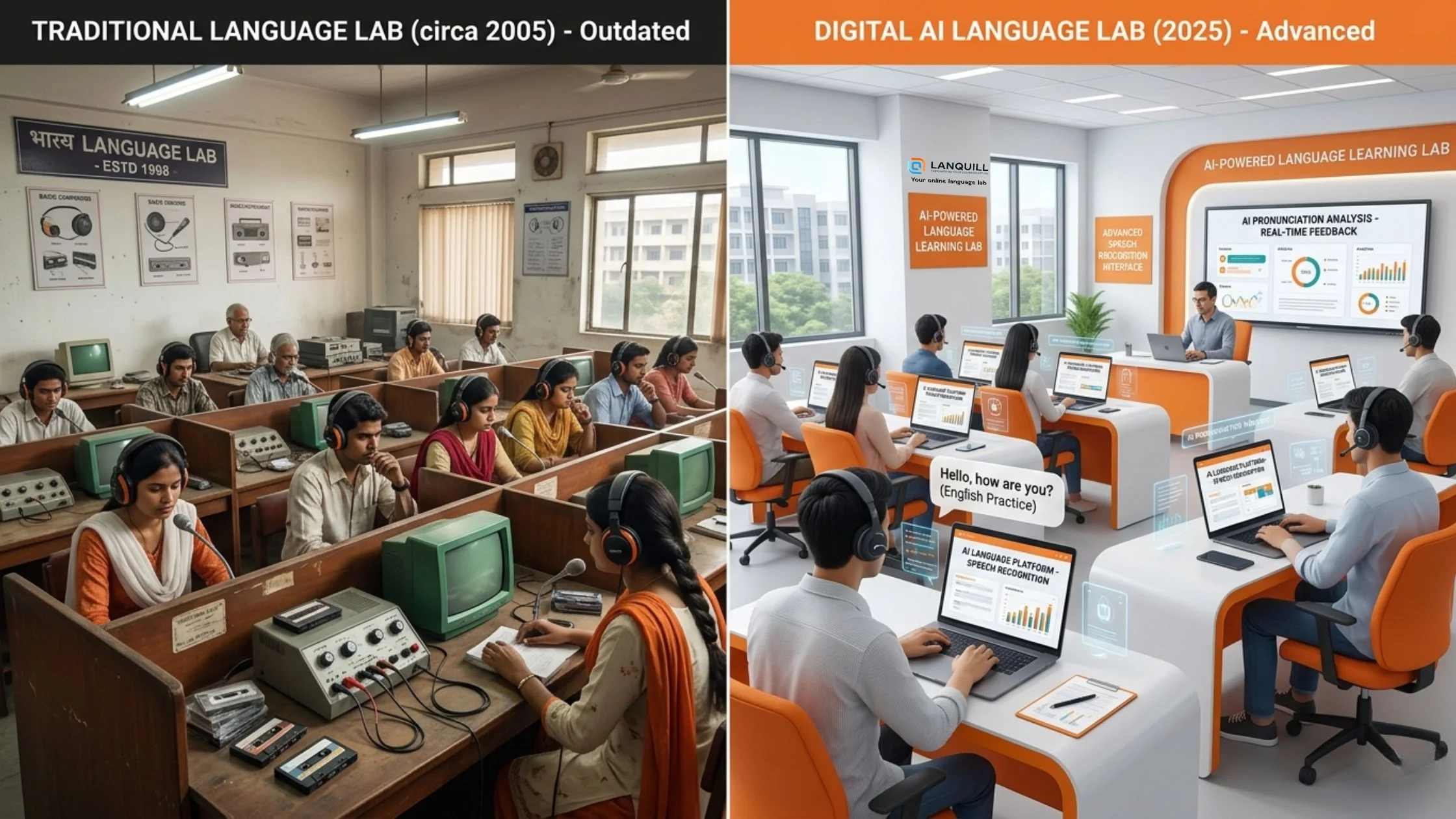
Traditional vs Digital Language Labs for Colleges (2026 Guide)
Compare traditional vs digital language labs and discover which is better for colleges to improve communication skills and placement outcomes.
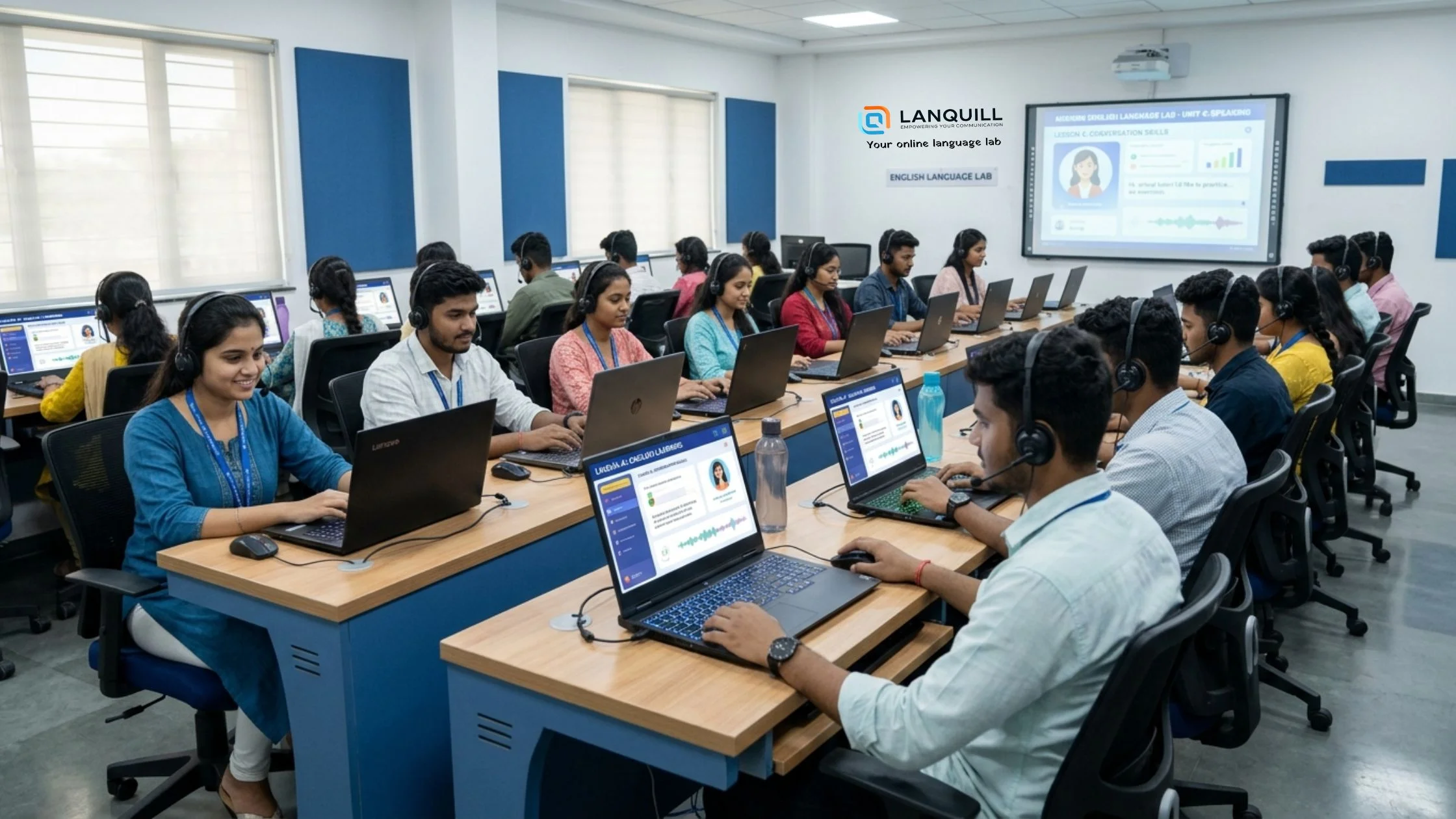
What is an English Language Lab for Colleges? Benefits Explained
Learn what an English language lab for colleges is and how it improves communication skills, placement readiness, and student outcomes.
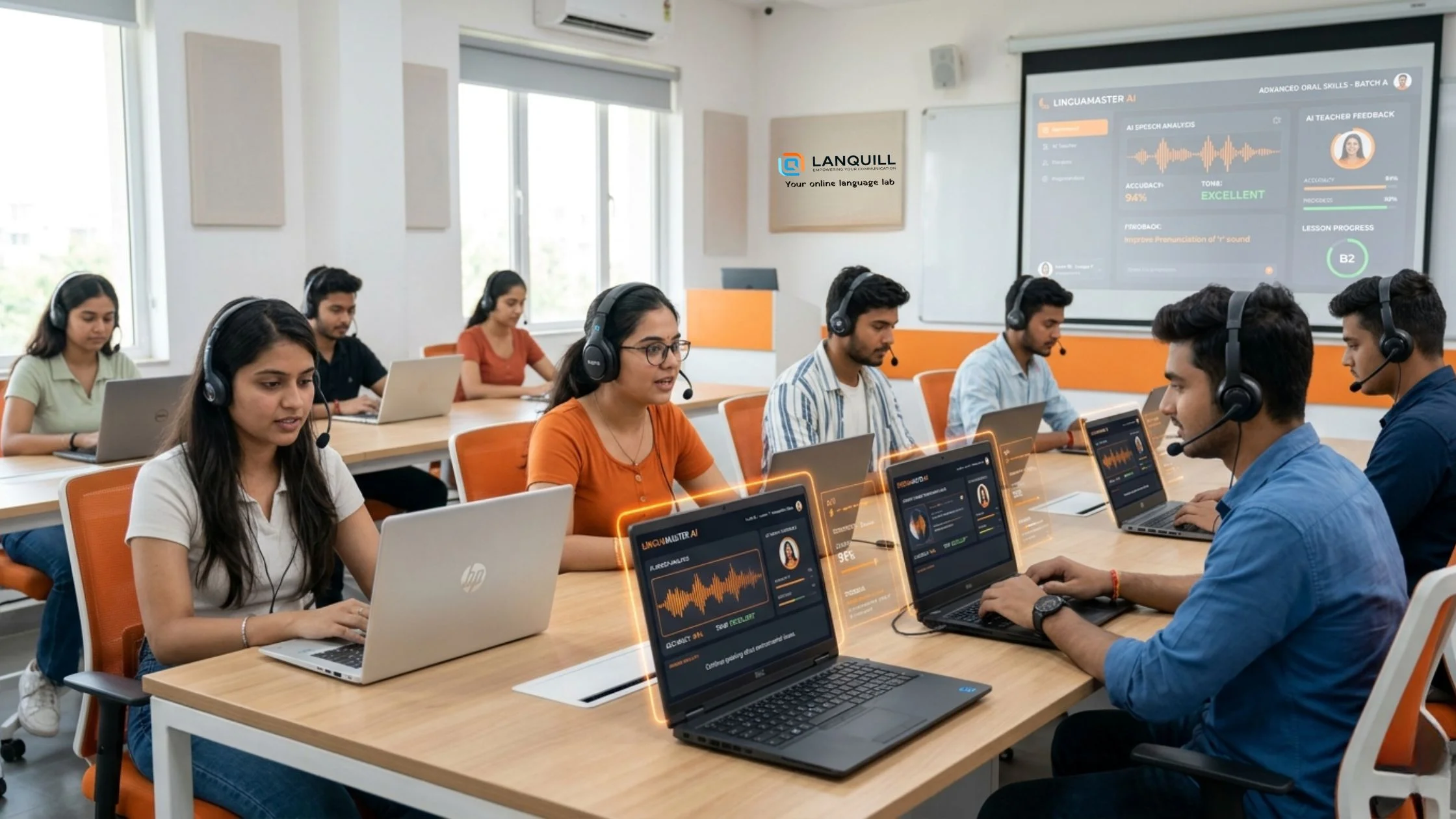
Why Every College Needs an AI Language Lab in 2026
Discover why every college needs an AI language lab in 2026 to improve student communication and placement readiness.
From Classroom to Career: How CEFR-Aligned English Courses Build Employability
Learn how CEFR-aligned English courses improve workplace communication and career readiness.
How Modern English Language Labs Are Transforming Communication Skills in Classrooms
Explore how modern language labs improve communication skills using technology.
English Spoken Classes vs English Language Lab: Key Differences You Should Know
Compare spoken English classes and language labs to understand their approaches and outcomes.